



Dr. Ma Linjuan Reveals Novel Mechanism of Long-Term Ovarian Damage in Offspring Following Prenatal PFOA Exposure
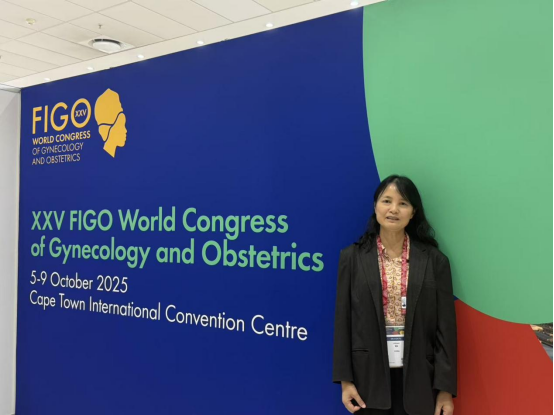
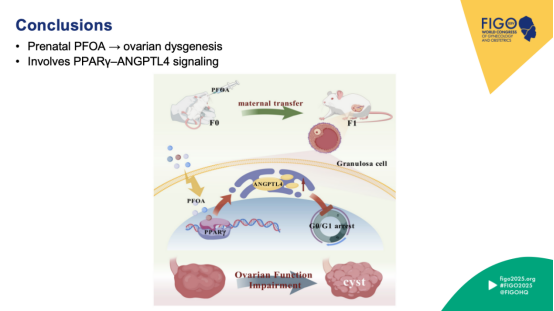
At the International Federation of Gynecology and Obstetrics (FIGO) 2025 Congress held on October 8, 2025, in Cape Town, South Africa, Dr. Ma Linjuan from the Women's Hospital,School of Medicine,Zhejiang University presented a significant discovery: Prenatal exposure to the environmental pollutant perfluorooctanoic acid (PFOA) can cause lifelong structural and functional damage to the ovaries of offspring by activating the PPARγ–ANGPTL4 signaling pathway.
The study, using a mouse model of prenatal PFOA exposure, demonstrated that exposed offspring exhibited varying degrees of ovarian structural and functional abnormalities across three life stages—prepubertal, mature, and middle-aged—including follicular developmental arrest, irregular estrous cycles, and ovarian cysts. Further mechanistic investigation revealed that the PPARγ–ANGPTL4 signaling pathway in granulosa cells was significantly activated during this process, providing critical insight into the reproductive toxicity mechanisms of PFOA.
Dr. Ma Linjuan delivered a dedicated presentation on this research at the FIGO 2025 Congress, engaging in in-depth discussions with global experts in obstetrics, gynecology, and reproductive medicine. This study not only provides new experimental evidence linking environmental pollutants to female reproductive health but also offers an important theoretical foundation for future population-based risk assessment and the development of targeted intervention strategies.